From 100 Pieces to 1,000: How to Scale Your Production Without Losing Quality
"Scaling is more than just adding zeros to your order. It's the moment your brand moves from manual hustle to industrial efficiency. Our latest guide, From 100 Pieces to 1,000, reveals the blueprint for scaling your production without compromising the quality that built your brand. Discover how to leverage apparel prototyping services, move to Full Package Production (FPP), and protect your margins as you grow."
H. Kay
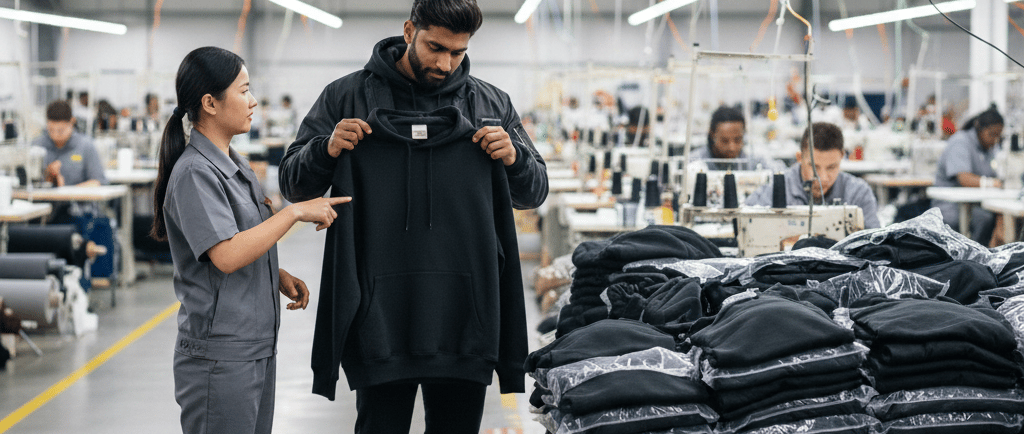
Scaling a streetwear brand is a "make or break" moment. Most founders start with small, local drops—maybe 50 to 100 pieces handled by a boutique sampling house or a local screen printer. But when demand spikes and you need to move to 1,000 units, the cracks in your foundation begin to show.
The transition from small-batch production to industrial-scale manufacturing is where quality often dies. Stitching becomes inconsistent, fabric weights fluctuate, and lead times stretch from weeks into months.
At Custom Apparel Studio, we specialize in manufacturing for fashion startups, helping brands navigate this exact growth phase. Here is your roadmap for scaling your production while maintaining the premium standards your customers expect.
1. Move from "Handmade" to "Process-Driven"
When you are making 100 pieces, you can personally inspect every garment. When you are making 1,000, you can't. You must transition your quality control from your own eyes to a formal Tech Pack.
A Tech Pack is the "blueprint" for your garment. It includes every measurement, fabric weight (GSM), thread type, and hardware specification. Without a professional Tech Pack, your manufacturer is guessing—and at scale, guessing leads to mass-produced errors.
If you aren't sure if your current supplier is up to the task, read our guide on How to Verify Your Clothing Manufacturer to ensure they have the certified mills required for high-volume output.
2. The Importance of Professional Apparel Prototyping Services
Scaling is not just about making more of the same thing; it’s about ensuring the design works for mass production. This is where apparel prototyping services become vital.
A "Sales Sample" (the version you show to the world) must be identical to the "Production Sample" (the version the factory actually makes). When scaling, you should request a Size Set—samples of your garment in every size from XS to XXL. A common mistake startups make is scaling only the "Medium" and assuming the "Large" will look right. In reality, the proportions of a streetwear fit change drastically at higher volumes.
3. Consolidation: The Secret to Manufacturing for Fashion Startups
In the early days, you might buy your fabric from one shop, your zippers from another, and take them to a third person to sew. This is called "CMT" (Cut, Make, Trim). While this works for 100 pieces, it is a logistical nightmare for 1,000.
To scale effectively, look for Full Package Production (FPP). This is where your manufacturer handles everything:
Sourcing certified fabrics directly from mills.
Developing custom trims and hardware.
Handling the cutting, sewing, and final quality control.
Consolidating your supply chain reduces the "points of failure" and ensures that if a zipper breaks, there is one person—the manufacturer—accountable for the entire product.
4. Managing the "Price vs. Quality" Paradox
As your volume increases, your "Price Per Unit" should decrease. However, many founders make the mistake of chasing the absolute lowest price, which forces the factory to use cheaper labor or lower-grade threads to maintain their margins.
Instead of cutting the quality of the material, scale your efficiency:
Standardize Fabrics: Use the same heavyweight cotton for three different designs. Buying 5,000 meters of one fabric is cheaper than buying 500 meters of ten different colors.
Optimize Patterns: Work with your pattern maker to reduce fabric waste. Even a 5% reduction in fabric "fall-out" can save you thousands of dollars at a 1,000-piece scale.
5. Implementing AQL (Acceptable Quality Level) Inspections
When you reach the 1,000-piece mark, you need a statistical way to measure quality. The industry standard is the AQL (Acceptable Quality Level) system.
Rather than checking 1,000 shirts, an inspector will pull a random sample (e.g., 80 pieces) based on a mathematical table. If the number of defects in that sample exceeds a certain limit, the entire batch is rejected. This puts the pressure on the factory to maintain high standards throughout the entire production run, not just the first few boxes.
FAQ: Scaling Your Clothing Production
Q: When is the right time to move from 100 to 1,000 pieces? A: When your "Sell-Through Rate" is consistently high. If you are selling out of 100 pieces in less than a week, you have a demand problem that only scaling can solve. However, ensure you have the cash flow to handle the larger deposit required for 1,000 units.
Q: Can I use the same manufacturer for small batches and large scale? A: Not always. Some "Sampling Houses" are designed for speed and precision on single items but aren't equipped for the "Assembly Line" logic of mass production. At Custom Apparel Studio, we help brands bridge this gap by offering scalable production tiers.
Q: How do I prevent my designs from being "knocked off" when I scale? A: Always sign an NNN (Non-Disclosure, Non-Use, Non-Circumvention) agreement before moving into large-scale production. This protects your intellectual property from being sold to other brands by the factory.
Q: Does scaling mean I have to move production overseas? A: Not necessarily. While overseas manufacturing offers lower costs at high volumes, many streetwear brands scale with domestic "Full Package" manufacturers to maintain faster lead times and lower shipping costs.
The Bottom Line
Scaling from 100 to 1,000 pieces is a shift in mindset from "Designer" to "Supply Chain Manager." By focusing on professional tech packs, FPP manufacturing, and statistical quality control, you can grow your brand without sacrificing the details that made you successful in the first place.

Contact
Reach out for custom orders or questions
Phone
© 2025. All rights reserved.