How to Start a Clothing Line in 2026: A Step-by-Step Manufacturing Guide
"Master custom apparel manufacturing in 2026. This comprehensive guide covers everything from sourcing sustainable fabrics and building a 'Color Story' to developing professional tech packs. Learn how to scale your fashion brand from 100 units to a national flagship store."
H. Kay
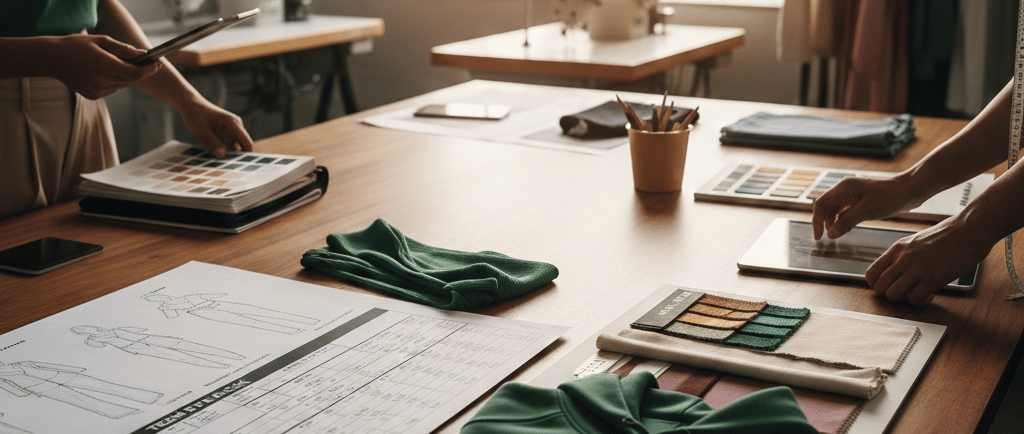
The fashion landscape of 2026 has moved beyond simple "merch." Today, success is found in the intersection of technical performance and ethical storytelling. Whether you are launching a flagship retail store or an emerging nationwide streetwear label, your journey begins with choosing the right custom apparel manufacturing partner to bridge the gap between creative vision and physical reality.
The Evolution of Production: Quality Over Quantity
In 2026, Google rewards "Helpful Content" and authoritative expertise. To satisfy both the algorithm and your manufacturer, you must focus on deep specifications. Detailed communication prevents the most common pitfalls in garment construction, such as inconsistent sizing or poor fabric performance.
Defining Your Niche and Identity
Don't just launch a "brand"; launch a solution. Success stories in our portfolio show that brands starting with a modest order of 100 essential pieces—like a perfectly weighted hoodie—often build a more loyal following than those with massive, low-quality collections.
The Essentials: Focus on consistent fit and premium materials.
The Uniform: Create high-quality staples for specific communities, focusing on certified organic materials.
Mastering Technical Fabric Sourcing
Fabric is no longer just about "hand-feel." In 2026, it is about technical specifications, durability, and chemical transparency.
Building a Cohesive "Color Story"
One of the hardest feats in custom apparel manufacturing is matching different textile compositions. High-end streetwear labels often require matching technical nylon (for cargos) to heavyweight cotton (for hoodies). We call this a "Color Story." Achieving 100% color precision across diverse textures is what elevates a brand to the editorial level. You can explore our Fabrics Education Page to see how we manage dye lots for different fibers.
Sustainable and Ethical Sourcing Standards
Sustainability is the 2026 industry standard. Utilizing GOTS-certified organic cotton not only helps the planet but provides a powerful marketing angle for your brand's narrative. Brands like Elena Rodriguez have proven that ethics and quality go hand-in-hand, allowing for expansion from local communities to nationwide reach.
The Technical Design Phase (Tech Packs)
A Tech Pack is the blueprint of your garment. It is the only way to ensure that the "concept" in your head matches the "reality" that comes out of the factory. Without a professional tech pack, manufacturing becomes a game of guesswork.
Key Components of a 2026 Tech Pack
Grading Scales: Ensuring your size Small fits as perfectly as your XXL through calculated proportional shifts.
Bill of Materials (BOM): An exhaustive list of every component, from zippers and thread types to custom buttons.
Construction Details: Specific instructions on seam types (e.g., flatlock vs. overlock) to ensure garment longevity. If you need assistance with this phase, our Technical Design Services can help you digitize your concepts.
Prototyping and the Sample Room
Before you move to mass production, you must validate your design through physical samples. This is where the "Color Story" is verified and the technical fabrics are tested for performance.
The Proto Sample: This is your "rough draft" to check the silhouette and drape of the fabric.
The PPS (Pre-Production Sample): This is the "gold standard" garment. Once approved, every unit in your bulk run will be compared against this piece.
Scaling Your Brand for the Flagship Level
Growth should be a ladder, not a leap. Start with a "Market Test" to gather customer feedback on durability and fit. Once you have validated the demand, scaling from 100 units to thousands per season becomes a matter of logistics rather than a risk.
Frequently Asked Questions (FAQ)
What is the average lead time for custom apparel manufacturing in 2026? Typically, the process takes 12 to 16 weeks. This includes fabric sourcing (4 weeks), sampling (2–4 weeks), and bulk production (6 weeks).
How do I ensure my colors match across different fabrics? This requires "Lab Dips." We test the dye on each specific fabric substrate—like technical nylon and cotton—to ensure they match perfectly under different lighting conditions.
Can I source 100% organic materials for my entire line? Absolutely. We specialize in sourcing certified organic cotton and recycled synthetics. You can read more about our mission on our About Us page.
Contact
Reach out for custom orders or questions
Phone
© 2025. All rights reserved.